Imagine for a moment that a critical shipment is on a cargo ship heading for Southeast Asia. A sudden, violent storm is forecast to hit, causing massive port congestion. For the next 24 to 48 hours, a human team would be scrambling. Emails would fly, meetings would be scheduled, and spreadsheets would be frantically updated to reroute the cargo.
Now, imagine a different reality. As the storm data hits the system, an AI agent instantly analyzes weather telemetry, port capacity, and contractual obligations. Within seconds, it simulates dozens of scenarios and reroutes the shipment through an alternate port. The disruption is minimized before most employees even finish their morning coffee.
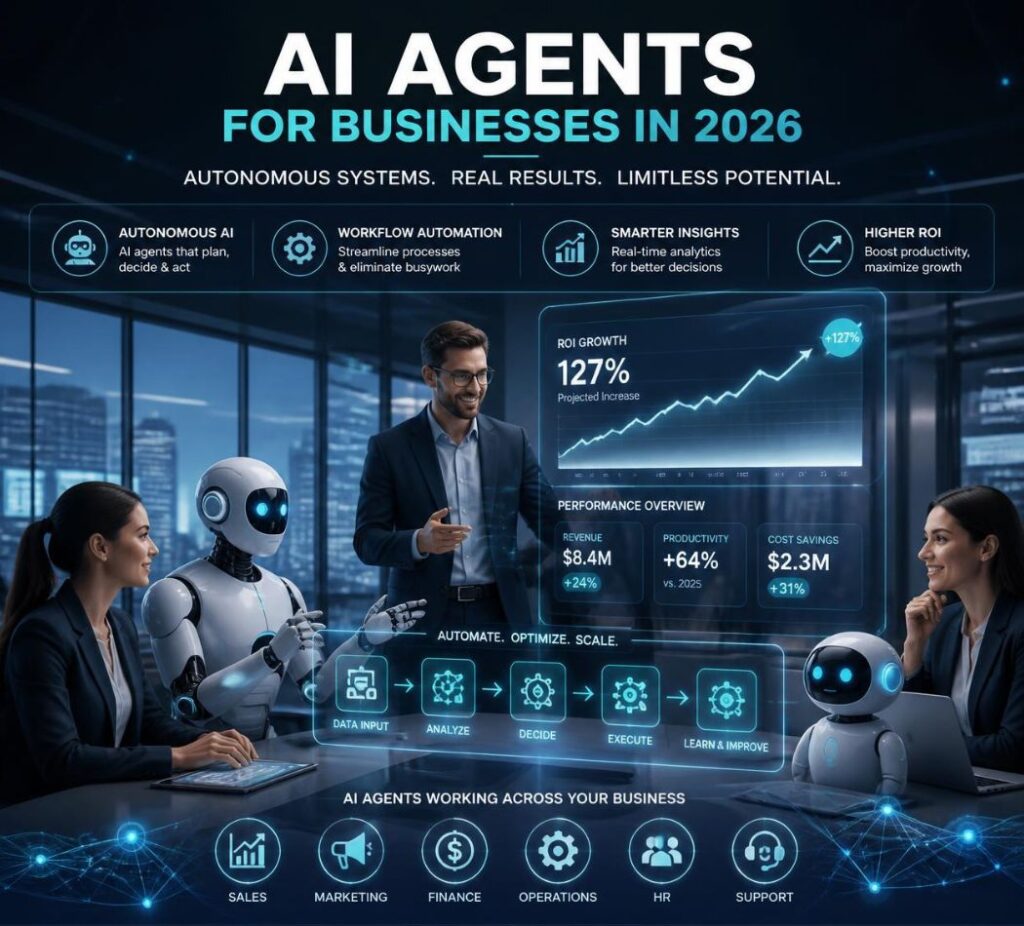
This is not science fiction. This is the reality of how AI agents work for businesses in 2026. They aren’t just fancy chatbots or simple automation tools; they are digital coworkers capable of reasoning, planning, and acting autonomously to achieve complex goals.
While it’s true that the concept is currently overhyped—with many vendors slapping the “agent” label on basic decision trees—the underlying shift is profound. A Gartner report predicts that by 2028, at least 15% of day-to-day work decisions will be made autonomously through agentic AI, up from 0% in 2024. This article cuts through the noise to explain what agents are, how they create value, and how you can deploy them responsibly.
Decoding Agentic AI: Beyond Basic Automation
To understand how AI agents work for businesses, you must first understand what they are not. Traditional Robotic Process Automation (RPA) is rule-based. If “A” happens, do “B.” A chatbot works on keyword matching. But an AI agent is different.
What is an AI Agent?
An AI agent is an autonomous software entity that perceives its environment, makes decisions, and takes actions to achieve specific goals. It is powered by Large Language Models (LLMs) which give it reasoning capabilities. However, the “agent” part comes from its ability to interact with the outside world via “tools.”
The “Tool” Analogy
Think of an LLM as a brilliant brain. It is incredibly smart but locked in a box. For that brain to actually do something—like book a flight or update a database—it needs hands and eyes. In the world of AI, these are called “tools” or “functions.”
For example, an agent might look at a user query, reason that it needs to access the company CRM, decide to use an API tool to pull customer data, analyze that data, and then use another tool to write an email response. This ability to plan, use tools, and act is what sets agents apart.
Key Components of an AI Agent System
When building an agent, you need to coordinate several layers:
-
The LLM Core: The reasoning engine.
-
Tools: APIs, integrations, and data connections that allow the agent to act (e.g., sending an email, checking inventory).
-
Memory: The ability to retain context across a conversation or workflow.
-
Orchestration Layer: The “brain” that plans the steps. This is often done using patterns like ReAct (Reason + Act), where the agent thinks about a problem, acts, observes the result, and thinks again.
-
Guardrails: Governance rules that prevent the agent from doing things like exposing sensitive data (PII) or making unauthorized purchases.
The Tangible Impact: Real-World Use Cases in 2026
The excitement surrounding agents is finally translating into action. Recent data shows that firms are moving from isolated bots to coordinated “agentic environments”. Here are the verticals where AI agents are delivering immediate value.
1. Customer Service: From Chatbots to Resolution Engines
This remains the “killer app.” Companies are moving beyond simple FAQ bots to agents that can actually fix problems. The goal isn’t just to answer a question; it’s to resolve the issue autonomously.
-
The Salesforce Case Study: Salesforce’s Agentforce handled 3 million support conversations, leading to a 8% drop in case volume and over $100 million in annualized cost savings. This wasn’t just automation; the agents maintained conversational context and escalated only when necessary. Some IT organizations using similar service agents have reportedly reduced ticket volumes by 60-70%.
-
Contextual Resolution: In finance, an agent can review transaction history, cross-check policy changes, and even coordinate with fraud-detection systems in real-time to resolve a billing dispute instantly, rather than letting it languish in a queue.
2. Supply Chain and Logistics: Self-Healing Operations
As highlighted in the intro, supply chains are the perfect environment for agentic AI due to the high number of variables. These agents can monitor telemetry and weather data to predict disruptions and reroute shipments. This is less about efficiency and more about building resilience. Manhattan Associates, for example, has commercialized autonomous agents that monitor operations and automatically remedy issues like warehouse bottlenecks.
3. Sales and Marketing: Monetizing the “Sawdust”
One of the most interesting insights for 2026 is how agents are driving revenue, not just saving costs.
-
Lead Engagement: Salesforce ran an internal experiment where they used an AI agent to autonomously engage “dormant leads”—low-priority prospects that were uneconomical for human sales reps to pursue.
-
The Results: The agent sent personalized outreach, asked qualifying questions, and identified genuine buying intent. It turned “sawdust” into revenue opportunities—representing a shift from AI as a cost-saver to AI as a growth engine.
4. Legal and HR: Democratizing Expertise
Agents are embedding expert knowledge into tools usable by non-experts. For example, a legal AI agent can help sales staff flag risky clauses in contracts without needing a lawyer to review every document. In HR, agents can handle complex benefits queries that used to require specialized knowledge.
The Essential Metrics: Measuring Success Beyond Speed
How do you know if your agent is actually working? You can’t manage what you can’t measure. Experts recommend tying agent behavior to business goals rather than just technical outputs.
1. Decision Quality
This measures the agent’s autonomy. You should track Decision Accuracy (does it pick the right workflow?) and Decision Consistency (is it predictable?). If two similar users get wildly different outcomes, trust erodes quickly.
2. Operational Resilience
This is about how the agent handles messy real-world data. Track the Error Rate and Recovery Time. If an AI agent rejects a valid ID, does it stop working, or does it know how to restart the process? Adaptability is key here.
3. Cost Per Outcome
This is the “unit economics” of AI. How much does it cost to resolve a support ticket compared to a human agent? You need to factor in compute costs, API usage, and the cost of human oversight.
4. Guardrail Adherence
How often does the agent try to “step out of bounds”? You need to know when it attempts to access unauthorized data or PII. Flagging these instances is critical for risk management and compliance.
Avoiding the Pitfalls: Why Agents Fail and How to Succeed
Despite the potential, many firms are stuck in “pilot purgatory.” The hype often outstrips reality. Here is a reality check based on recent findings.
The Top Mistakes
-
Trying to Do Too Much Too Fast: Organizations often try to transform entire business functions in one leap. This creates resistance and makes issues hard to isolate.
-
Garbage In, Garbage Out: Deploying agents on poor data is like hiring a genius and refusing to give them access to company files. Poor data quality slows adoption and leads to bad outcomes.
-
Building Instead of Buying: While frameworks (like LangChain) are great for prototyping, they often require extensive custom engineering to reach production readiness. Managing memory, security, and scale without native governance makes these agents brittle.
-
The “Hype” Trap: Not every problem needs an agent. Sometimes a calendar tool or a simple workflow automation is sufficient. Using an agent to schedule a meeting is overkill.
The Solution: A Framework for Success
To ensure success, you need a readiness framework:
-
Start with High-Value Use Cases: Focus on “data-rich” tasks where agents can handle exceptions in dynamic environments.
-
Implement Human-in-the-Loop (HITL): For high-stakes decisions, build in an approval mechanism. The agent handles 90% of the work but pauses for human review on the final action. This builds trust and ensures accountability.
-
Focus on Governance: Establish clear “rules of the road” for agents. Define permissions, escalation paths, and ethical boundaries.
Future Trends: What’s Next for AI Agents?
As we look toward the end of the decade, several trends are shaping the future of agentic AI.
1. The Rise of “Multi-Agent” Systems
We are moving from single agents to “swarm intelligence.” Multiple specialized agents (e.g., a document agent, an assessment agent, a fraud agent) will collaborate around a shared goal. They will negotiate and self-organize like a digital workforce.
2. Suite-First Integration
Standalone agents are becoming obsolete. The true value unlocks when agents are deeply integrated into enterprise suites (like ERP systems). Companies like SAP and Oracle are embedding agents into their core platforms so they act with full business context rather than being siloed tools.
3. Agent-to-Agent Communication Standards
Protocols like A2A (Agent-to-Agent) and MCP (Model Context Protocol) are emerging to allow different agents to talk to each other seamlessly, regardless of who built them.
4. AI Contributing to Revenue (Not Just Savings)
The transition is already happening. In 2025, the focus was operational (cutting costs). In 2026 and beyond, the focus is shifting to growth—unlocking new revenue streams by pursuing leads and markets that were previously too expensive to target.
Conclusion: Are You Ready for Your Digital Workforce?
AI agents are no longer a novelty; they are a structural shift in how work is done. They promise to compress cycle times, reduce errors, and unlock trillions of dollars in global economic value. However, the path to success is littered with over-ambitious failures.
The companies that will win are not necessarily the ones with the biggest budgets, but the ones that treat agentic AI as a strategic capability rather than a tech demo. They start with high-value, data-rich problems, they build in rigorous governance and human oversight, and they measure success by business outcomes, not just “model accuracy.”
Key Takeaways:
-
Define, Don’t Automate: Agents are for complex, dynamic tasks that require reasoning, not simple rules.
-
Start Small, Think Big: Begin with a focused pilot that delivers immediate ROI (like lead qualification or tier-1 support) to build confidence.
-
Prioritize Data: Clean, structured, and accessible data is the fuel for your AI workforce.
-
Measure ROI Holistically: Track cost-per-resolution and decision accuracy alongside traditional metrics.
-
Build for Trust: Implement “Human in the Loop” systems and guardrails from day one to prevent errors and ensure compliance.
The era of the digital co-worker is here. The only question left is whether your business will be a spectator or a participant.
Frequently Asked Questions (FAQs)
1. How do AI agents work for businesses compared to standard chatbots?
Standard chatbots respond to specific keywords based on a predefined script. AI agents, however, use reasoning. They can understand context, plan a multi-step approach to solve a problem, and take action by using tools like APIs to actually change data in your CRM or ERP system.
2. Are AI agents safe and secure?
They can be, provided you build them with strict guardrails. This includes defining permissions (what data they can access), implementing human-in-the-loop approval for critical actions, and ensuring data residency and audit logs are in place. Governance and transparency are non-negotiable for enterprise use.
3. How much does it cost to implement an AI agent?
Costs vary widely. You can prototype using open-source frameworks with minimal cost, but scaling requires significant investment in infrastructure, security, and specialized teams. Many enterprises are turning to low-code “AI agent builders” which offer predictable pricing compared to custom builds.
4. What is the biggest mistake businesses make with AI agents?
The most common mistakes are applying agents to problems that don’t need them (using a sledgehammer to crack a nut) and neglecting data quality. Deploying an agent on siloed or outdated data is a recipe for hallucination and poor performance.
5. What is a “multi-agent system”?
This is where multiple specialized AI agents are coordinated to work together. For example, in insurance, one agent handles document intake, another assesses the claim, and a third checks for fraud. They collaborate to complete a complex task much like a human team would.
Sources
-
BairesDev. (2026). How Agentic Systems Work and When They’re Worth It.
-
ISG/Nasdaq. (2026). U.S. Firms Adopt Agentic Automation for Integrated Operations.
-
NTT DATA. (2026). Build smarter business processes with agentic AI.
-
FAIR EDIH. (2025). AI Agents in Business: A Practical Overview.
-
Domo/Nasdaq. (2026). Domo Launches AI Agent Builder and MCP Server.
-
Moveworks. (2026). How to Create Intelligent AI Agents That Work.
-
SAP News. (2026). The Suite Spot: A Practical Guide to Business AI Agents.
-
Forbes. (2026). The CMO’s Guide To Scaling Agentic AI.
-
Sirma. (2025). Orchestrating Business Processes with AI Agents.
-
Manhattan Associates/Nasdaq. (2026). Manhattan Associates Announces Commercial Availability of its AI Agent Workforce.
-
Oracle. (2026). Accelerating Enterprise Automation using Agentic AI in Oracle Integration.
-
Fortune. (2026). AI’s next act: how Salesforce is turning efficiency gains into revenue.