Imagine walking into a room where the future isn’t something you predict—it’s something you design. A place where instead of asking “Where are we headed?” you ask “Where do we want to be, and what will it take to get there?”
This isn’t science fiction. It’s the promise of the back casting room, a dedicated physical or virtual space designed around one of the most transformative strategic planning methodologies in existence today .
And here’s the surprising truth: while most organizations spend their strategy sessions tinkering with incremental improvements—forecasting next quarter’s numbers, adjusting budgets, projecting current trends forward—the most innovative teams are working backwards from a bold vision of success. The difference isn’t subtle. It’s the difference between navigating by looking in the rearview mirror and steering toward a destination you’ve chosen deliberately.
Consider this: a study of strategic planning approaches found that traditional forecasting works well when the future resembles the past. But when you’re tackling complex, long-horizon challenges—reaching net-zero emissions, entering a market that doesn’t yet exist, or redesigning an entire city’s transportation network—forecasting falls short . That’s where back casting shines.
The back casting room is where this magic happens. It’s where teams gather to “dream big” , then methodically reverse-engineer the path from that dream to the present. And if you’ve never experienced one, you’re missing out on what might be the most effective strategic tool of the decade.
What Is Back Casting, Really?
Let’s clear up a potential confusion first. The term “back casting” has multiple meanings in different contexts. In this article, we’re talking about back casting as a strategic planning methodology—not fly fishing or shore casting techniques, which also use the term.
Here’s the core distinction:
-
Forecasting asks: “Given where we are today and current trends, where are we likely to end up?”
-
Back casting asks: “Given where we want to end up, what must happen between now and then?”
In academic terms, back casting was formally proposed by researcher John Robinson in 1982 as a method for energy policy analysis. Since then, it has evolved into a versatile planning framework used across environmental planning, corporate strategy, urban development, product roadmapping, and more.
Back casting works because it flips the planning problem on its head. Instead of being constrained by “what’s realistic right now,” teams start with an ambitious end state and work backward. This approach tends to surface bolder, more innovative ideas because participants aren’t limited by current constraints when envisioning the future.
What Makes a Back Casting Room Different?
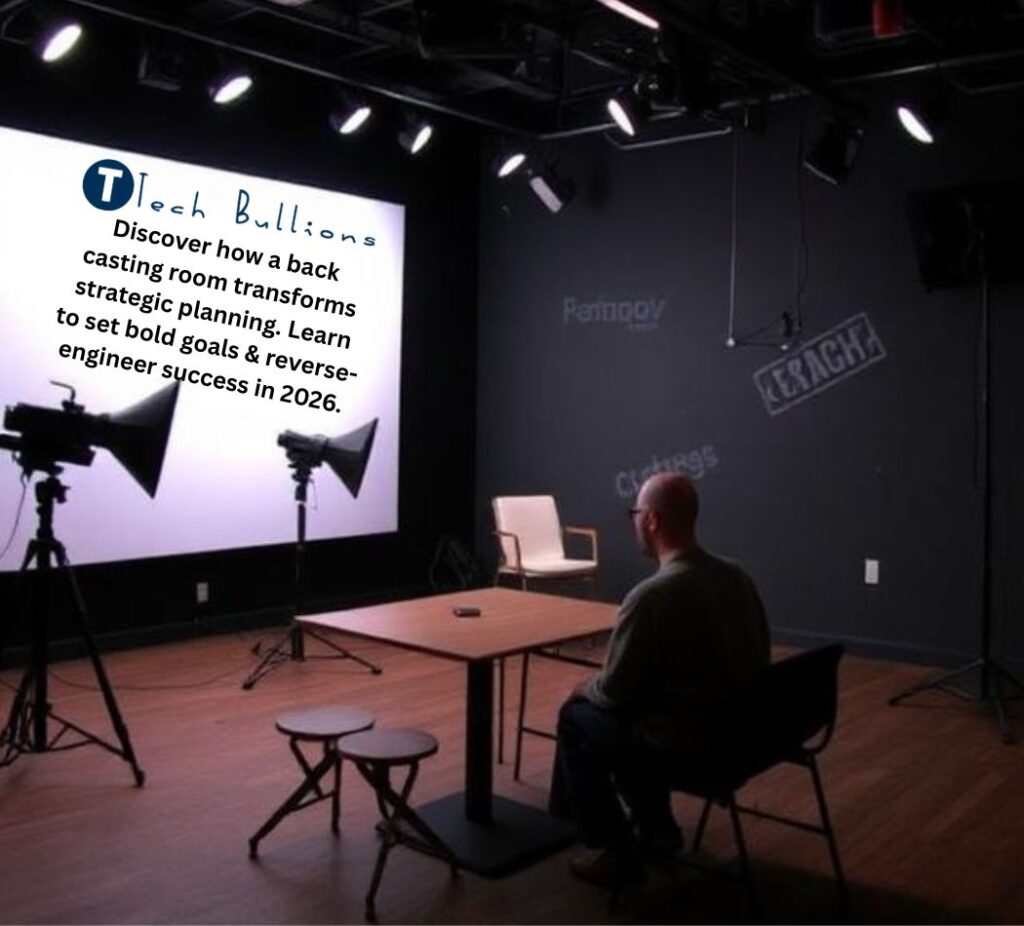
A back casting room isn’t just a conference room with a nicer name. It’s a deliberately designed space—physical or digital—that supports the unique demands of backward planning.
The Visual Canvas
The best back casting rooms are visual spaces. Whiteboards, large-format timelines, projectors, sticky-note walls, and digital displays all help make abstract future scenarios feel tangible. Because back casting depends on mapping a path across time, teams need somewhere to actually lay that path out and see it as a whole.
Collaboration Infrastructure
Whether it’s shared digital whiteboards, roadmapping software, or simple shared documents, the space must support real-time collaboration. Multiple perspectives need to be captured, compared, and merged on the fly.
A Creative Atmosphere
Back casting asks people to imagine possibilities that don’t exist yet. That’s harder to do in a sterile, rushed environment. Comfortable seating, good lighting, and enough space to move around all help the kind of creative thinking the process demands.
Structured Facilitation
Because the process moves in an unfamiliar direction, someone needs to guide the session—keeping the group anchored to the end vision while they work through the intermediate steps. This facilitator should be neutral, not someone with a vested interest who might inadvertently silence dissenting voices.
How Organizations Use Back Casting Rooms
The beauty of back casting is its versatility. Here’s how different sectors are applying it:
Environmental and Sustainability Planning
This is where back casting has its deepest roots. Teams working toward ambitious goals like carbon neutrality use back casting rooms to define what “success” looks like concretely, then work backward to identify the policy changes, infrastructure investments, and behavioral shifts needed to get there.
Corporate Strategy
Businesses use back casting to set long-term goals—entering a new market, launching a category-defining product, achieving specific growth targets—and then reverse-engineer the roadmap. This ensures near-term decisions actually serve the long-term destination instead of just reacting to quarterly numbers.
Urban and Civic Development
City planners use back casting to envision livable, sustainable cities decades out, then work backward to zoning decisions, transit investments, and housing policy needed now to make that future possible.
Product and Technology Roadmapping
Teams building emerging technology often can’t rely on forecasting because the market doesn’t fully exist yet. Back casting lets them define the end-state product or capability and reason backward to today’s engineering priorities.
How to Run a Back Casting Session: A Step-by-Step Guide
Ready to try it? Here’s a practical framework adapted from successful implementations across industries :
Step 1: Choose the Right People
Include everyone who has a part in implementation and success. That means not just leadership, but also the people who will actually execute the plan. Consider running separate sessions for different groups if your organization is large.
Step 2: Set Aside Time
Schedule about a half-day for the session. This isn’t something you can cram into an hour—though even shorter visioning exercises can be useful as a starting point.
Step 3: Envision a Desirable Future
Encourage participants to imagine a specific point in the future (2-5 years out is common). Ask: “What does success look like?” Consider factors like culture, processes, market position, and specific outcomes. This vision should be ambitious yet achievable.
Step 4: Prioritize and Assign
Prioritize future goals and assign topics to breakout groups. Each group is tasked with identifying sequential steps needed to move from present reality to the desired future. This is where the “reverse engineering” happens.
Step 5: Drill Down to Action
Go one level deeper. For each step, identify:
-
What needs to happen
-
Who is responsible
-
By when it needs to be completed
This transforms strategy into action planning.
Step 6: Group Debrief
Each breakout group presents their conclusions to the full group. This shifts ownership from smaller groups to everyone.
Step 7: Follow Through
Initiatives die without follow-through. Leadership should meet shortly after to refine the plan and hold initiative leaders accountable for implementation.
Common Pitfalls and How to Avoid Them
Even with the best setup, back casting sessions can stumble. Here are the most common challenges:
Pitfall 1: The “Success Theater” Trap
Teams create a vision that looks good but lacks real ambition because they’re afraid to dream big.
Solution: Explicitly encourage wild thinking. The Swedish city of Kiruna uses a “Drömscenario” method that asks teams to imagine the best possible reality and not let calendar time, economic resources, or anything else limit them.
Pitfall 2: Dominant Voices
A few strong personalities overwhelm quieter participants.
Solution: Use a neutral facilitator and consider breakout groups of 2-3 people where everyone has space to contribute.
Pitfall 3: The “Stuck at Present” Problem
Teams can’t break free from current constraints when envisioning the future.
Solution: Start by defining the desirable future first, before any discussion of current limitations. This is the essence of back casting.
Pitfall 4: Analysis Paralysis
Teams get bogged down in details and never complete the plan.
Solution: Keep momentum. The goal is action, not perfection. Remind participants that the plan can be refined later.
Back Casting vs. Other Planning Methods: A Quick Comparison
To understand the back casting room’s unique value, it helps to see how it differs from alternative approaches:
| Approach | Starting Point | Direction | Best For |
|---|---|---|---|
| Forecasting | Current trends | Forward | Predictable environments |
| Scenarios | Multiple possible futures | Sidways/exploratory | Understanding uncertainty |
| Back Casting | Desirable future | Backward | Ambitious, long-term goals |
| Incremental Planning | Current state | Forward (small steps) | Stable conditions |
The key insight is that back casting isn’t always the right tool. It’s most valuable when:
-
You have a clear, ambitious vision
-
The path from here to there isn’t obvious
-
You need to surface novel strategies
The Future of Back Casting Rooms
As of 2026, the back casting room concept is evolving in several directions :
Hybrid and Virtual Spaces
With distributed teams becoming the norm, organizations are creating virtual back casting rooms with advanced collaboration tools—digital whiteboards, roadmapping software, and virtual facilitation capabilities.
Integration with AI
Early adopters are experimenting with AI tools to help identify critical milestones, flag inconsistencies in backward planning, and even suggest alternative pathways to the desired future.
Formalization as a Service
Some consulting firms now offer “back casting room as a service”—turnkey setups with facilitators, templates, and follow-through support. This lowers the barrier for organizations that lack internal expertise.
Expansion Beyond Strategy
Back casting is increasingly being used for innovation sprints, product discovery, and even personal life planning.
Key Takeaways
-
A back casting room is a dedicated space (physical or virtual) designed for backward-planning strategic sessions.
-
Back casting starts with a desirable future and works backward to the present, unlike forecasting which projects current trends forward.
-
The methodology originated in environmental planning and has spread to corporate strategy, urban development, and product roadmapping.
-
Effective back casting rooms feature visual tools, collaboration infrastructure, a creative atmosphere, and neutral facilitation.
-
A successful session includes the right people, a clear future vision, prioritized goals, action planning with accountability, and follow-through.
-
Common pitfalls include lacking ambition in the vision, dominant voices, difficulty breaking free from present constraints, and analysis paralysis.
-
Back casting is ideal when you have an ambitious long-term goal and the path forward isn’t obvious. It’s less suitable for stable, predictable environments.
Frequently Asked Questions
Q: How is back casting different from goal setting?
A: Goal setting typically defines a desired outcome but stops there. Back casting adds the rigorous reverse-engineering step—mapping what must happen, in what sequence, to achieve that outcome.
Q: How much time should I allocate for a back casting session?
A: A half-day is ideal for a comprehensive session. Shorter visioning exercises (1-2 hours) can be useful as a starting point or for less complex goals.
Q: Can I do back casting without a dedicated room?
A: Yes. While a purpose-designed space helps, the methodology works anywhere you can gather and collaborate. Digital tools make virtual sessions increasingly effective.
Q: What’s the ideal group size?
A: For breakout work, groups of 2-3 are optimal. For the full session, you can include larger numbers, but ensure everyone has a chance to contribute.
Q: How far into the future should we plan?
A: 2-5 years is common and manageable. Longer horizons (10+ years) are possible but require more assumptions and flexibility.
Q: Is back casting only for environmental planning?
A: No. While it originated in sustainability, back casting is now used in corporate strategy, urban development, product roadmapping, and more.
Q: What happens after the session?
A: The real work begins. Participants refine the plan, assign accountability, and track progress. Regular reviews help maintain momentum.
Sources
-
“Creating a Backcasting Room: A Guide,” Coohom, 2026
-
“Back Casting Room: Everything You Should Know Before Getting Started,” Kanect, 2026
-
“Back(casting) to the Future: How Working Backwards Can Help Your Strategic Planning Process,” Association of Legal Administrators, 2024
-
“Drömscenario,” Kiruna kommun (Kiruna Municipality), 2022
-
Kelly, M. (2021). “Embedding Sustainability across the Built Environment Curriculum” [citations: Robinson, 1982; Robinson, 2003; Quist, 2007]