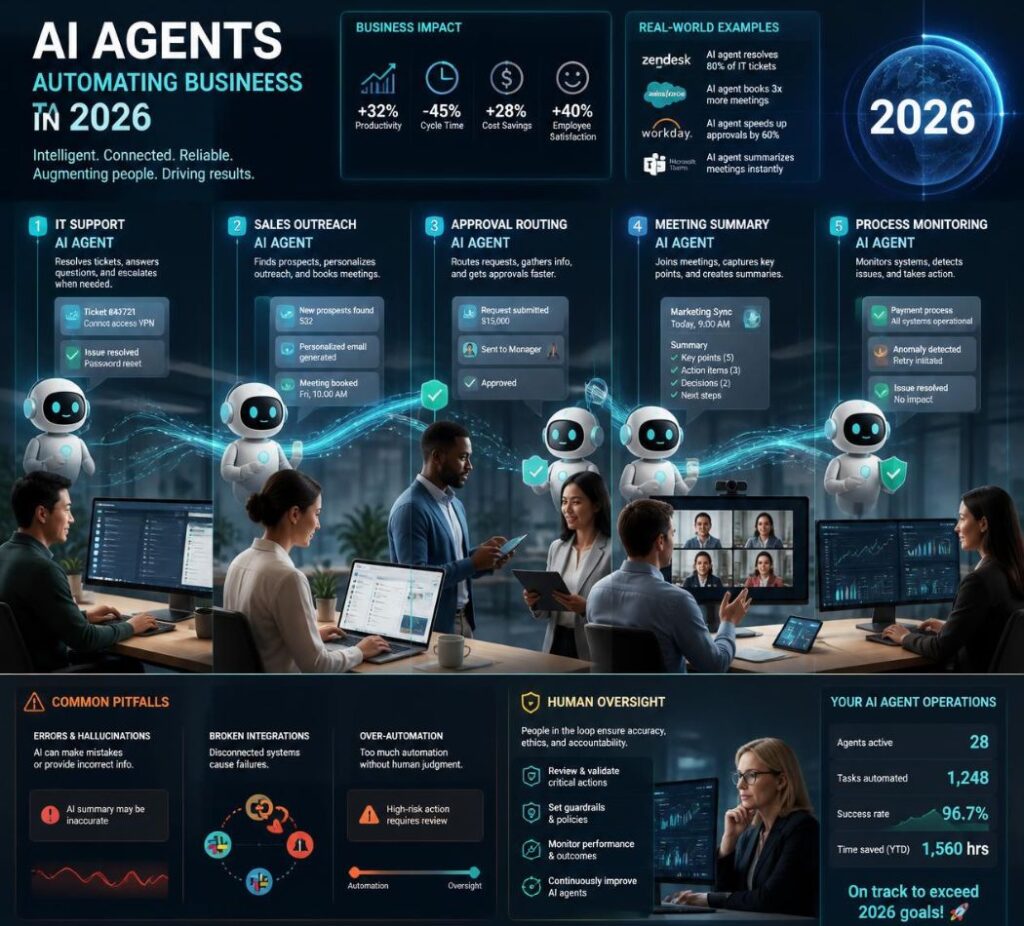
How AI Agents Automate Business Tasks: Imagine coming back from a full day of meetings to find your busywork already done: stalled deals followed up on, compliance changes summarized, and meeting prep written. Not because you multitasked, but because something was working in the background on your behalf.
This isn’t a vision of a distant future. It’s the reality for organizations deploying AI agents in 2026.
For years, we’ve heard that AI would transform how we work. But the chatbots and copilots most employees have experienced were just the opening act. A bigger shift is now underway as agentic AI ushers in the next stage of enterprise intelligence.
These tools don’t just wait for prompts. They set goals, break work down into steps, coordinate with systems, make decisions, and act. They learn from outcomes and improve over time. So, how exactly are AI agents automating business tasks, and what does this mean for you and your organization?
What Are AI Agents?
Before diving into applications, let’s clarify what we’re talking about. Think of an AI agent as a digital employee. Unlike a traditional chatbot that requires a prompt for every single action, an agent can understand a complex goal and figure out the steps to achieve it.
Researchers define agentic AI along two vectors: autonomy and context integration.
-
Autonomy is the ability to plan and act with limited human intervention.
-
Context integration is the ability to read from and write to your digital environment, including your computer, browser, and external services.
This means an agent can not only suggest a solution but also execute it by updating systems, sending emails, or generating reports.
The “Why Now?” of Agentic AI in Business
Several factors are converging to make 2026 the year AI agents move from pilot to production.
-
Maturing Technology: Protocols like Agent2Agent (A2A) are making it easier for agents to connect and communicate, even if they are from different developers or built on different frameworks.
-
Pressure on CIOs: A staggering 74% of CIOs say their role is at risk if they don’t deliver measurable business gains from AI within the next two years. This creates a massive incentive to deploy agents that deliver real ROI.
-
The Failure of Legacy Automation: Traditional Robotic Process Automation (RPA), which relies on rigid scripts, has a 30-50% failure rate. It’s fragile and breaks when software interfaces change. AI agents, which can “see” and adapt to screens like a human, offer a more robust solution.
How AI Agents Automate Core Business Functions
AI agents are automating workflows across nearly every business function. Here’s how they’re making an impact.
1. IT and Service Desk Support
IT teams are leading the charge in deploying AI agents. The results are often dramatic.
-
Automated Ticket Triage: One financial services firm built a workflow where incoming support tickets are automatically analyzed, categorized, prioritized, and updated without any human intervention. The system has processed hundreds of tickets in this manner, saving countless employee hours.
-
Service Desk Resolution: ServiceNow moved 85% of its own service desk employees to higher-level jobs after deploying AI agents that improved service requests from first touch to resolution by 90%. The remaining employees were retrained to manage the AI agents.
2. Customer Service
Customer service is being transformed by agents that can resolve issues end-to-end, rather than just deflecting them.
-
Rapid Issue Resolution: An agent can handle a complex billing discrepancy by reviewing transaction history, checking return-policy eligibility, processing the refund in the payment system, and updating order management—all without a human agent ever touching the ticket.
-
Reduced Ticket Volume: According to NTT DATA, some IT organizations have reduced ticket volumes by 60%–70% by deploying service agents.
3. Finance and Operations
Finance and operations are prime areas for AI agents, where they can manage risk and streamline manual work.
-
Fraud Detection: AI agents are cross-checking transactions against millions of historical records to detect anomalies and approve or reject activity on the spot. Some institutions have cut the number of fraudulent transactions in half.
-
Risk Management: Agents can be extended to manage credit exposure, liquidity risk, and regulatory reporting continuously.
4. Marketing and Sales
Marketing is a hot spot for agentic AI, driven by the ability to deliver more targeted campaigns and immediate cost savings.
-
Hyper-Personalized Campaigns: Klaviyo’s AI platform uses data from over 200,000 businesses to provide insights into what consumers want, helping marketers tune their ideas to fit customer needs.
-
Self-Correcting Sales Outreach: An agent can qualify leads, draft personalized emails, and follow up with stalled deals, even working on a continuous basis.
The 5 Workflow Automation Patterns That Actually Work
Based on real-world deployments, five patterns separate successful AI agent implementations from failures.
-
Sequential Task Chains: The agent completes a step, uses the output to decide the next step, and so on. This is simple and effective for finance workflows like invoice processing.
-
Parallel Agent Swarms: Instead of one agent doing ten tasks in sequence, ten agents do them simultaneously. This can cut a 4-hour research job down to 20 minutes.
-
Human-in-the-Loop Checkpoints: The agent handles 90% of the work autonomously but surfaces only the ambiguous or critical cases for human review. This builds trust and executive buy-in.
-
Reactive Event-Triggered Agents: The agent sits idle until a trigger fires—a new email, a form submission, a file appearing in a folder—then executes a full workflow automatically.
-
Self-Correcting Feedback Loops: The agent runs a task, checks its output against a success condition, and retries with a modified approach if it fails. This is crucial for reliability.
Common Challenges and How to Solve Them
Despite the promise, deploying AI agents isn’t without its hurdles. Understanding these challenges is key to a successful implementation.
The “Pilot to Production” Gap
The Problem: Over 60% of enterprises have adopted or piloted AI agents, but only somewhere between 11% and 31% have successfully scaled those pilots into production. Many projects stall.
The Solution: The problem often lies in messy data, legacy systems, and a lack of an enterprise-grade orchestration platform. Organizations need a central layer to manage agent permissions, task routing, monitoring, and fallback logic. Treat agent orchestration as infrastructure, not as a one-off project for each use case.
Governance and Security
The Problem: Autonomy without governance is a liability. If an agent has the ability to act on systems, what happens if it makes a mistake or is given a malicious prompt?
The Solution: Organizations must implement “agentic guardrails,” which are policies that govern what agents can and cannot do.
-
Visibility: Every action an agent takes needs to be logged and auditable.
-
Access Control: An agent handling customer refunds shouldn’t have the ability to access HR systems. Permissions should be tightly scoped to the task at hand.
-
Validation Layers: Before an agent’s output reaches a database, a customer, or a financial system, it should pass through a validation layer that checks the action against defined business rules.
Pros, Cons, and a Balanced Analysis
It’s easy to get swept up in the hype. Here’s a realistic look at the benefits and drawbacks of using AI agents.
Pros
-
Massive Productivity Gains: An AI agent and human workflow reduced average task completion time from 269 minutes to 36 minutes—an 87% reduction—according to a study from the Harvard Business School AI Institute.
-
Tireless Operation: Agents work continuously, even while you’re in back-to-back meetings or offline, handling tasks around the clock.
-
Reduced Human Error: Agents consistently follow rules and processes, eliminating the errors that can occur with manual data entry or routing.
-
Enhanced Workforce: When employees are freed from mundane tasks, they can focus on higher-value strategic work.
Cons
-
High Setup Cost: While the marginal cost of each step an agent takes is low, the fixed cost of setting up the goal and verifying the output is high. Agents only pay off once a task is long enough to “amortize the setup”.
-
The “Black Box” Problem: If you can’t understand why an agent made a decision, it creates trust issues and complicates auditing.
-
Job Displacement Anxiety: While many companies (like ServiceNow) have not reduced headcount, the fear of job loss is real and can create resistance to adoption.
-
Ongoing Oversight Required: Humans are still needed to set direction, review outputs, and handle exceptions. Agents are not a “set and forget” tool.
Future Trends and Predictions: How AI Agents Automate Business Tasks
What does the future hold for AI agents? Here are some key trends to watch.
-
The Rise of Multi-Agent Systems: The real transformative potential lies in multiple agents working together to orchestrate and execute tasks across platforms and even organizations. An agent representing a buyer could negotiate with an agent representing a seller.
-
Domain-Specific Models: We’ll see a move away from general-purpose models toward agents trained for specific sectors like healthcare, finance, and manufacturing to reduce risk and improve accuracy.
-
Embedded AI is King: AI embedded in established apps and search engines will be three times more common than use through standalone AI sites. It will feel less like a “tool” and more like a core feature of the software you already use.
-
Build vs. Buy: As tools become more accessible, some businesses will build their own custom AI tools rather than relying on off-the-shelf services to get a perfect fit with their internal workflows.
Key Takeaways
-
AI agents are not just chatbots. They are autonomous digital workers that can plan, execute, and learn.
-
Start with internal, “low-hanging fruit” like IT ticket triage and service desk operations to build experience and confidence.
-
Success requires process redesign. Don’t just apply AI to a broken process—redesign the workflow around intelligence-first principles.
-
You need a foundation for success. That means a robust platform for agent orchestration, good data hygiene, and strong security guardrails .
-
The future is multi-agent. Teams of agents will work together to automate complex workflows, reshaping how entire industries operate.
FAQs About How AI Agents Automate Business Tasks
What is the difference between a chatbot and an AI agent?
A chatbot is a reactive tool that responds to prompts. An AI agent is a proactive digital worker that can set goals, plan steps, and take action across multiple systems with limited human oversight.
Is it hard to build and deploy an AI agent?
Not necessarily. Major software vendors like Oracle and platforms like Amazon Quick now allow users to create agents in minutes using plain language descriptions, with no coding required. However, scaling a pilot to a production-grade, governed system requires more planning.
Will AI agents take away my job?
In many cases, the goal is to augment human workers, not replace them. When ServiceNow deployed agents, they moved 85% of their service desk team to higher-level roles. It’s about automating tasks, not eliminating people. AI agents expand the “frontier of tasks worth attempting,” allowing people to focus on more cognitively complex work they couldn’t previously afford.
What’s the most common mistake when deploying AI agents?
The most common mistake is applying an AI agent to a poorly mapped or broken process. This just amplifies inefficiencies. You must redesign the workflow for the agent’s capabilities, not just overlay the agent on top of the old process.
What is multi-agent AI, and why does it matter?
Multi-agent AI involves multiple agents working together and communicating to execute complex tasks. This is what unlocks the next level of automation, as agents can simulate entire teams working in concert across different functions and organizations.
Note: This article incorporates real-world findings from research reports, industry analysts (ISG, Gartner, IDC), vendor case studies (Google Cloud, Oracle, ServiceNow, Amazon Quick), and a working paper from the Harvard Business School AI Institute.