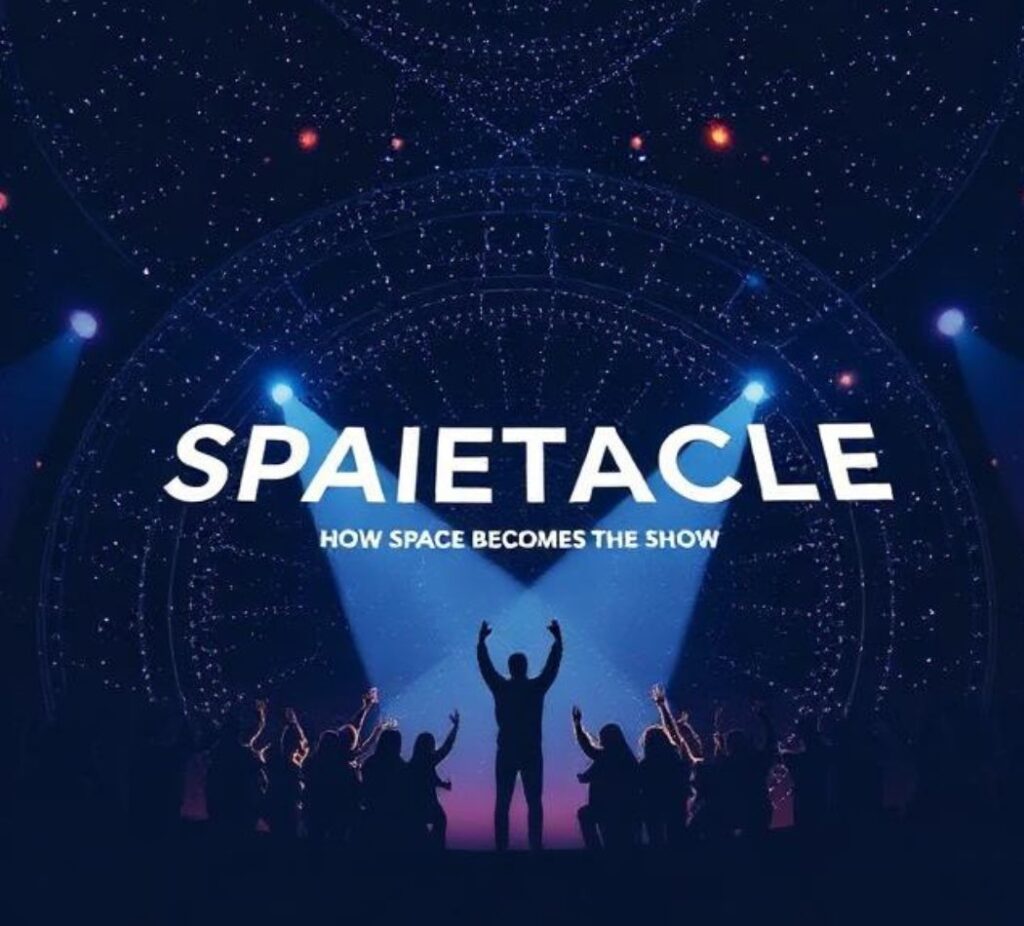
Imagine this: you’re not sitting in an audience watching a performance. You’re walking into a forest that breathes. Leaves rustle under your feet. Starlight flickers with your steps. Trees slowly bloom as you approach. You’re not a spectator — you’re part of the space itself.
That’s what spaietacle is trying to do.
If you haven’t heard the term yet, you’re not alone. Most people haven’t. But if you’ve experienced a TeamLab immersive exhibition, watched a Travis Scott virtual concert in Fortnite, or stood in a brand pop-up where light and sound wrapped around you until you forgot you came to shop — you’ve already touched the early form of spaietacle.
What Exactly Is Spaietacle?
Spaietacle is a concept built from “space” and “spectacle.” It describes a new form of experience: the space itself becomes the medium, and the audience shifts from passive viewer to active participant.
Traditional spectacle is “I show, you watch.” A film, a stage play, a light show — no matter how spectacular, the audience stays in a fixed seat, separated from what’s happening by a safe distance. Spaietacle removes that distance. It asks you to step inside, measure the space with your body, trigger change with your actions, and complete the experience with your emotions.
A clearer comparison:
| Dimension | Traditional Spectacle | Spaietacle |
|---|---|---|
| Audience role | Viewer | Participant |
| Spatial relationship | Space is background | Space is the narrative vehicle |
| Sensory engagement | Primarily visual | Multi-sensory, synchronized |
| Interactivity | Minimal or none | Core mechanism |
| Memory strength | Depends on content quality | Depends on personal experience depth |
The difference looks subtle but is fundamental. When you do something in a spaietacle — wave your hand to scatter petals, step on a floor that triggers sound, make a choice inside a space — the memory is no longer “what I saw” but “what I lived through.”
Why Now? The Logic Behind Spaietacle’s Rise
Spaietacle didn’t appear out of nowhere. It’s a response to an increasingly obvious problem: attention has become the scarcest resource of our time.
Modern people are bombarded daily by thousands of ads, short videos, and push notifications. The brain has evolved an efficient filter: skip anything unimportant. Traditional “display-receive” communication struggles to penetrate this defense. Not because people don’t care, but because information overload makes everything feel equally unimportant.
Spaietacle’s solution isn’t “be louder.” It’s “be more memorable.” Neuroscience has repeatedly confirmed: people remember feelings more than information. You might forget ten short videos you scrolled past yesterday, but you’ll remember the slight dizziness of wonder the first time you stepped into an immersive light space.
That’s the logic of spaietacle: instead of fighting for eyeballs, create memories.
The Five Core Components of Spaietacle
If you want to understand or design a spaietacle experience, break it into five elements that must work together:
1. Immersive Space
Space isn’t a container — it’s the content itself. Walls, floors, ceilings all participate in the narrative. Projection mapping turns ordinary physical surfaces into dynamic canvases. Visual content can adapt to any shape, creating illusions of depth and motion.
2. Layered Senses
Light, sound, touch, temperature, scent — spaietacle engages more than one or two senses. When multiple senses activate simultaneously, the “realness” of the experience rises exponentially. This is why immersive Van Gogh exhibitions can make a static painting deeply moving: you’re not looking at The Starry Night, you’re surrounded by it.
3. Emotional Anchor
Every successful spaietacle starts with an emotional goal, not a technical solution. The designer’s first question should be: “What do I want people to feel?” Wonder, calm, connection, or some hard-to-name nostalgia? Technology is the means, not the end.
4. Interaction Mechanism
Interaction doesn’t have to be complex. Sometimes a single motion sensor is enough: you raise your hand, the space responds; you stay still, the environment quiets with you. That feeling of “being seen” is one of spaietacle’s most powerful psychological hooks.
5. Narrative Thread
Every element in the space should serve a larger story or theme. Without narrative, immersion is just decoration. With narrative, experience gains meaning, and participants understand their place within that meaning system.
Who Is Actually Using Spaietacle?
The term is still new, but its practice has landed across multiple industries.
Entertainment and live events are spaietacle’s most visible stage. In 2020, Travis Scott’s virtual concert in Fortnite drew over 27 million concurrent players. The audience “floated” around the performer in the game, traveling through impossible visual landscapes. That wasn’t watching a concert — that was being inside one.
Museums and art institutions are spaietacle’s most natural habitat. TeamLab’s immersive exhibitions in Tokyo, Shanghai, and beyond let visitors change the flow of light and shadow with their bodies. ARTECHOUSE in Washington, D.C., uses projection mapping and sensor technology to turn gallery spaces into dynamic art installations. Van Gogh immersive experiences have drawn more than 5 million visitors worldwide.
Retail and brand experience is using spaietacle as a differentiation weapon against e-commerce. Nike’s House of Innovation and Apple’s flagship stores use spatial design, lighting atmosphere, and narrative flow to turn shopping into “entering a brand world.” Brands no longer shout “buy this” — they say “come feel this.”
Education turns abstract knowledge into experiential content. VR chemistry labs let students conduct dangerous reactions safely. Immersive history scenes make “walking into ancient Rome” literal rather than metaphorical.
Digital platforms are spaietacle’s rapidly expanding new frontier. Some platforms are evolving into collaborative spaces where creators publish immersive experiences, supporting real-time editing, virtual co-creation, and streaming. An artist in Japan can collaborate with a director in Brazil to create a shared experience for audiences in France.
How to Design a Spaietacle Experience: A Practical Framework
If spaietacle’s possibilities attract you and you want to try designing one — whether a small pop-up space, an online interactive page, or a brand event — here’s a framework distilled from practice:
Step 1: Start with Emotion, Not Technology
Ask yourself: “What do I want participants to feel when they leave?” Calm? Curiosity? Connection? “Did I just experience something special?”
This answer determines every subsequent choice. If your goal is calm, you won’t choose high-saturation visuals and fast-paced sound. If your goal is wonder, you need to design a rhythm of “discovery.”
Step 2: Design an “Entrance” and an “Exit”
Good immersive experiences have clear boundaries. Participants need to know they’re “entering” another space. This entrance can be a door, a transition corridor, a guiding sound — any signal that prepares them to switch modes.
The exit matters equally. The experience’s closing needs to give participants time to digest and return to daily states. An abrupt ending breaks the emotional arc.
Step 3: Make Interaction “Discoverable but Not Over-Explained”
The best interactions are ones participants “discover” themselves. You don’t need a sign on the wall. Spatial design should naturally guide behavior: a faintly glowing floor area makes people want to step on it; a suspended sensor device makes people want to reach out.
When participants discover the rules of interaction themselves, they gain a sense of control and achievement. That “I figured it out” moment is itself part of the spaietacle experience.
Step 4: Test the “No-Instruction” Version
Give your design to a few people with no background information. Don’t explain anything. Observe what they do, where they hesitate, where they get excited. Their natural behavior tells you whether the design works.
Step 5: Accept “Uncontrollability”
In spaietacle, you design conditions, not outcomes. Each person interacts with the space in their own way, producing different experience paths. This isn’t a flaw — it’s a feature. Let go of the obsession that “every participant gets exactly the same experience.” Accept that personalization is the endpoint of immersion.
Common Mistakes and Challenges
Mistake 1: Treating “Tech Stacking” as “Immersive Design”
VR headsets, projectors, motion sensors — these are tools. Tools don’t create experience; intention does. A small space using only light and sound but designed with care can be more memorable than a hall stuffed with the latest equipment but lacking narrative.
Mistake 2: Chasing “Big” While Ignoring “Dense”
Spaietacle’s impact doesn’t depend on space size or production budget. A carefully designed 10-square-meter interactive installation, with sufficient emotional density, can be more powerful than a vast, empty exhibition.
Challenge 1: Cost and Sustainability
High-quality immersive experiences require investment in technology, design, and content creation. Equipment maintenance, content updates, and space operations are ongoing costs. For small creators, balancing experience quality and financial sustainability is a real difficulty.
Challenge 2: Privacy and Data Ethics
When experiences rely on sensors and real-time data collection, how participant behavioral data is used, stored, and protected becomes an unavoidable issue. Transparent data policies and designs that respect participant choice should be spaietacle’s baseline.
Challenge 3: Inclusivity
Intense sensory stimulation in immersive experiences may be uncomfortable or even harmful for some people. Photosensitive epilepsy, vestibular disorders, sensory processing sensitivity — designers need to consider how to offer adjustable intensity for people with different abilities, rather than excluding some with a “one-size-fits-all” approach.
The Future Direction of Spaietacle
Several emerging trends are worth watching:
Spatial Computing and AI Personalization. As devices like Apple Vision Pro and Meta Quest push spatial computing into the mainstream, spaietacle’s “space” will increasingly be mixed reality. AI can adjust difficulty, pace, and even narrative branches in real time based on participant behavior, giving each person a truly individual version.
From “Event” to “Venue.” Most current spaietacle experiences are temporary — an exhibition, an event, a pop-up. More permanent immersive spaces may emerge, becoming fixed parts of urban life like cinemas or gyms.
Decentralized Creator Ecosystem. Some platforms are lowering the technical barriers to immersive content creation, letting independent creators and small teams publish and monetize spaietacle experiences. This democratization could spawn creative forms we can’t yet imagine.
Neuroscience-Driven Design. As understanding of the neural mechanisms behind “awe,” “presence,” and “empathy” deepens, future spaietacle design may trigger specific emotional responses more precisely. This is both exciting and worth caution — when experience design can precisely manipulate emotion, ethical boundaries need to be established in parallel.
Key Takeaways
-
Spaietacle = space + spectacle. It turns viewers into participants and space from background into content.
-
It responds to attention scarcity and experience hunger. In an age of information overload, making people remember is more valuable than making them see.
-
Emotion is primary; technology is secondary. The best spaietacle starts with “what do I want people to feel,” not “what equipment do I have.”
-
Five core components: immersive space, layered senses, emotional anchor, interaction mechanism, narrative thread.
-
Applications go far beyond entertainment. Education, retail, healthcare, cultural preservation, and urban design are all adopting spaietacle logic.
-
Challenges are real: cost, privacy, inclusivity, digital fatigue — responsible design must face these.
-
Future directions: spatial computing, AI personalization, permanent immersive venues, creator democratization.
Frequently Asked Questions
Q: What’s the difference between spaietacle and “immersive experience”?
Immersive experience is a broader category emphasizing sensory envelopment. Spaietacle more specifically points to a design philosophy where “space as spectacle” is central, especially emphasizing that space itself becomes the core vehicle for narrative and emotion, and that participant action influences the experience.
Q: Do I need a VR headset to experience spaietacle?
No. Many spaietacle experiences are physical installations using projection, lighting, sound, and sensors. VR and AR are optional technology layers, not defining requirements.
Q: What’s the relationship between spaietacle and the metaverse?
The metaverse is a persistent digital world. Spaietacle is an experience design method that can happen in the metaverse, in physical space, or both. The metaverse is “where,” spaietacle is “how.”
Q: As an individual creator, do I have a chance to make spaietacle?
Yes. You don’t necessarily need a big budget. A thoughtfully designed interactive light installation, a small exhibition with a narrative thread, an online experience that responds to participant behavior — all can be spaietacle. The key isn’t scale; it’s design intention.
Q: Can spaietacle experiences be “addictive” or detached from reality?
This is a legitimate concern. Any strong immersive experience can potentially be overused. Responsible design includes clear experience boundaries, natural exit mechanisms, and respect for participants’ right to disconnect.
Sources
The analysis in this article is based on conceptual discussions and case information from the following public sources:
-
The Globe and Mail (2026) on the psychological, cultural, and digital dimensions of spaietacle
-
Emperor Magazine (2025) on immersive experience design and industry applications
-
IPS News (2026) on spaietacle and the evolution of digital spectacle
-
Bloglovin materials on visual storytelling and projection mapping technology
-
Dreaming Freedom (2026) on foundational spaietacle concepts and practical guides
-
Madi Magazine (2025) on case studies and industry data regarding the future of digital experience
-
The Greater (2025) on spaietacle philosophy and cross-industry applications
-
City Robots (2026) on spaietacle as a creative cultural concept and linguistic analysis
Note: Spaietacle is an emerging term not yet included in mainstream dictionaries. The definitions and frameworks in this article are based on a synthesis of existing public discussion, extended with analysis grounded in design practice and experience psychology.