Google AI Search vs. Traditional Search: Which One Wins in 2026?
Julian Sterling September 8, 2026 0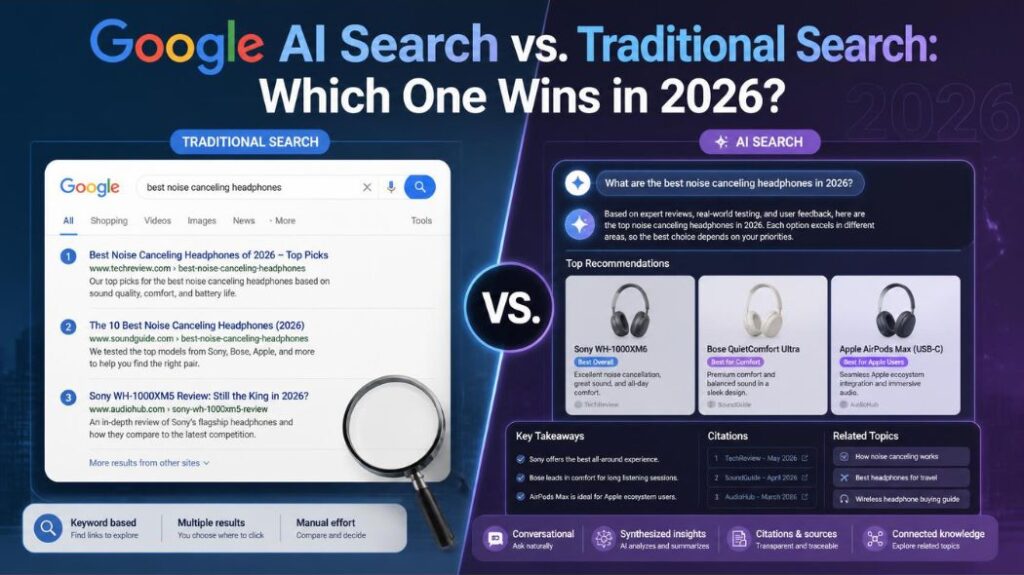
Imagine you’re standing in a grocery store, staring at a shelf of gochujang, unsure which brand is best. You can vaguely recall a cooking show’s recommendation, but the memory is fuzzy. Do you pull out your phone, type a few keywords, and start sifting through a pile of links? Or do you snap a photo, upload it, and get an immediate, definitive answer?
This isn’t a hypothetical scenario from a sci-fi movie; it’s a real-world use case of Google’s AI search, and it highlights a fundamental shift in how we interact with information. For over two decades, the “traditional search” experience—typing keywords into a box and receiving a list of ten blue links (the famed “10 blue links”)—has been the undisputed gateway to the internet. But with the explosive integration of Generative AI, we’ve entered a new era. The search engine is transforming into an “answer engine”.
This blog post isn’t just a dry technical comparison. We’ll explore the clash of these two titans, cutting through the hype to provide a balanced, authoritative, and practical analysis. We’ll look at what this means for you, the everyday user, and peer into the future of the web itself. Welcome to the ultimate showdown.
Background & Context: The Evolution of Finding Stuff
To understand the revolution, we must first appreciate the foundation. For a long time, traditional search (think Google or Bing) worked on a simple but powerful principle: keyword matching. You’d type in a string of words, and the search engine would scour its index—a massive, constantly updated catalog of web pages—to find the best matches. It would then rank these results based on hundreds of factors, famously including PageRank, to deliver what it believed was the most relevant and authoritative list of links.
This system is like a master librarian. It doesn’t give you the answer to your question; instead, it points you to the exact shelf and book where you can find it. It’s your job to read the book, cross-reference, and figure it out.
Then came the ChatGPT eruption in late 2022. It introduced a new paradigm: instead of a list of links, you could get a synthesized, natural-language answer. It felt like having a conversation with a know-it-all professor. The trade-off? You traded transparency for convenience. You got an answer, but you often didn’t know the source, and you had to trust that the AI wasn’t just making things up—a phenomenon known as “hallucination”.
Since then, Google, the king of traditional search, has been playing catch-up and leading the charge in a new direction. They launched AI Overviews, which are summaries that appear at the top of some traditional search results. More recently, they unveiled a dedicated “AI Mode” and even “Agentic Search,” which fundamentally reimagines the search experience. The very foundation of the web, the hyperlink, is being re-evaluated as we know it.
Main In-Depth Sections: A Head-to-Head Comparison
Let’s break down the core differences between these two approaches.
The Core Difference: Links vs. Answers
This is the fundamental distinction.
-
Traditional Search is a librarian. It directs you to documents. You, the user, are the researcher, responsible for evaluating and synthesizing the information. The interface is a list of links.
-
AI Search is a researcher. It scours documents, synthesizes the information, and presents you with a finished summary or even a dynamic tool. The interface is an answer, a widget, or a mini-app. The goal is to resolve your query without you ever needing to click a link.
How They Work: Retrieval vs. Generation
The “how” is just as important as the “what.”
-
Traditional Search: It uses a retrieval mechanism. A web crawler (also called a spider or bot) constantly scours the web, indexing pages. When you search, it retrieves the most relevant pages from this index and ranks them based on factors like quality, backlinks, and keyword relevance.
-
AI Search: It uses a generative mechanism, powered by Large Language Models (LLMs). Many AI search engines also use a technique called Retrieval-Augmented Generation (RAG). Instead of just generating an answer from its training data, it first performs a traditional search to retrieve relevant, up-to-date information from the web. It then uses this context to generate a coherent, well-structured answer. This helps to reduce (though not eliminate) hallucinations.
User Experience: Active vs. Passive
The way you use each tool shapes your entire experience.
-
Traditional Search is “Active.” It requires you to be a digital detective. You have to come up with the right keywords, filter out the noise (ads, low-quality content), click through to pages, read them, and synthesize the information yourself. It’s a skill, and it’s a more active, engaging process.
-
AI Search is “Passive” (or seemingly so). It does the heavy lifting for you. You can ask a question in natural, conversational language, and you get a polished, easy-to-digest answer. This is incredibly efficient, but it can also lull you into a false sense of security, making you less critical of the information presented.
Practical Tips & Actionable Advice: When to Use Each
This isn’t about declaring a winner; it’s about using the right tool for the job. Think of it like a toolkit. You wouldn’t use a sledgehammer to hang a picture, and you wouldn’t use a precision screwdriver to demolish a wall. Here’s a guide:
Lean on AI Search When:
-
You need a quick summary. You want an overview of a complex topic, like “What are the key principles of the Kyoto Protocol?” AI Overviews and tools like Perplexity are perfect for this.
-
You’re shopping. As we saw in the gochujang and car part examples, AI is brilliant for comparing products, identifying items from photos, and finding deals.
-
You’re brainstorming. Need ideas for a blog post, a gift, or a vacation? AI can generate a wealth of concepts and synthesize inspiration.
-
You’re planning. For complex tasks like planning a trip with specific constraints (“find flights to Oahu in July that arrive before 4 pm, as I have a toddler”), AI excels at weaving in personalized criteria.
Stick with Traditional Search When:
-
You need to verify a fact. If you need an absolutely irrefutable answer (e.g., a specific date, a historical event, a medical recommendation), you should always cross-reference with a direct, authoritative source. Traditional search gives you the path to that source.
-
You want to explore deeply. When you want to see the full debate, read different perspectives, or consult expert analysis, you need the context that only a full article or academic paper can provide. The AI summary may only give you the most common take.
-
You’re looking for a specific website. If you know what site you want, just type it in.
-
You are concerned about hallucination. A study by the Tow Center found a 60% error rate in some chatbot responses. For critical decisions, the direct sourcing of traditional search remains safer.
Common Challenges & Solutions: Navigating the Pitfalls
Both systems have their weaknesses.
AI Search Challenges
-
Hallucinations: The biggest problem. AI will confidently state falsehoods as facts.
-
Solution: Always check the provided citations (if any). If a claim seems important, verify it through a traditional search. Be a critical consumer of AI-generated text.
-
-
Lack of Transparency: It can be difficult to know why an AI gave you a specific answer, or what information it ignored.
-
Solution: Ask follow-up questions. “What are the counterarguments?” or “Where did you get this information?” can force it to be more transparent.
-
-
Bias: AI models are trained on vast datasets from the internet, which contains human biases. The AI can inadvertently amplify these biases.
-
Solution: Be aware that the AI is not neutral. Its perspective is a reflection of the data it was trained on.
-
Traditional Search Challenges
-
Information Overload: You can often get thousands of results, many of which are low-quality, spammy, or irrelevant.
-
Solution: Use advanced search operators (e.g.,
site:,filetype:) to filter your results. Learn how to evaluate a source’s authority and credibility.
-
-
SEO Manipulation: Results can be skewed by companies and content creators who have gamed the search ranking algorithm.
-
Solution: Be a discerning consumer. Look beyond the first few paid and organic results.
-
Pros & Cons: A Balanced Analysis
Let’s get down to the nitty-gritty.
Traditional Search: Pros and Cons
| Pros | Cons |
|---|---|
| Transparency: Shows you the exact sources of information. | Time-Consuming: Requires you to read and synthesize information yourself. |
| Depth: You can access the full depth and nuance of content | Can be Overwhelming: Often provides an excess of information, some of it low-quality. |
| Verifiability: You can easily check and cross-reference sources. | SEO-Driven: Results can be gamed by commercial interests. |
| Control: The user is in the driver’s seat. | Less Intuitive: Requires skill in crafting effective search queries. |
AI Search: Pros and Cons
| Pros | Cons |
|---|---|
| Speed and Efficiency: Provides an answer in seconds. | Potential for Inaccuracy: Prone to “hallucinations” and factual errors. |
| User-Friendly: Allows for natural language queries. | Lack of Transparency: Sources aren’t always clear or available. |
| Synthesis: Summarizes vast amounts of information into a digestible format. | Bias: Can reinforce the biases in its training data. |
| Personalization: It can tailor answers to your specific context (e.g., “with a toddler”). | Less Depth: For complex topics, it may provide a superficial overview. |
Future Trends & Predictions: The Next Five Years
The trajectory of search is clear. The era of the answer engine has begun. Here’s what’s on the horizon:
1. The Rise of the “Agentic” Web
Google’s new “Agentic Search” is a game-changer. Instead of just finding information, it can act on it. Imagine asking Google to compare prices for a new TV, read user reviews, and then schedule a delivery time for the best option—all without you lifting a finger. Sundar Pichai describes this as moving from a “retrieval engine” to an “agent manager”.
2. The “Generative UI”
Search results won’t just be text. They’ll be dynamic, interactive experiences. You might search for “how does an RNA polymerase work” and get an interactive 3D model you can manipulate, rather than a wall of text. This is the “Generative UI” where every search could create a custom, mini-application.
3. The Decoupling of Content from Webpages
This trend is arguably the most disruptive. The traditional web economy relied on a simple transaction: Google sends you traffic, and you monetize that traffic with ads. With AI search answering your query directly, there is far less need to click through to a website. According to Similarweb, almost 70% of news search queries no longer result in a click that takes the user out of Google. This is forcing publishers to rethink their business models entirely, focusing on subscriptions, direct relationships with audiences, and licensing deals with AI companies.
4. A Dramatic Shift in Website Traffic
The days of a single authoritative website dominating search results for a keyword may be numbered. Research shows that AI search tools often pull content from less popular sources, giving a broader, more diverse range of sites a chance to be cited, regardless of their traditional ranking. This could flatten the playing field for content creators.
Conclusion & Key Takeaways
The battle between Google AI search and traditional search isn’t a war to be won; it’s a transformation to be navigated. Search is no longer just a tool; it’s becoming an intelligent assistant. Traditional search isn’t going to disappear overnight, but its role is changing. It will become the fallback for verification, deep research, and finding specific sources. AI search will be the default for speed, convenience, and complex tasks.
Key Takeaways
-
Traditional Search is a “Librarian” that gives you resources to find answers yourself.
-
AI Search is a “Researcher” that synthesizes and provides an answer for you.
-
Use AI for summaries, shopping, and brainstorming.
-
Use Traditional Search for verification, deep research, and direct sourcing.
-
The Future is Agentic: AI will increasingly act on your behalf, not just answer questions.
-
The Web Economy is Changing: Publishers must adapt to a world where fewer people click through to their sites.
-
Be a Critical Consumer: Whether you’re using a link or an answer, always question its source and validity.
The future of search is here. It’s more powerful, more intuitive, and more integrated into our lives than ever before. The key to success lies not in picking a side, but in understanding the unique value of each tool and using them together to navigate the vast, ever-expanding library of human knowledge.
Detailed FAQs
Q1: Is Google AI search (AI Mode) better than traditional Google search?
A: “Better” depends on the task. AI search is better for getting quick summaries, comparing products, and understanding complex topics with conversational prompts. Traditional search is better for verifying facts, finding specific websites, and diving deep into a subject where you need to see the full context and range of sources.
Q2: Does Google AI Mode replace traditional search results?
A: Not entirely. AI Mode is not the default experience for all queries. Google has stated that users will still get a range of results, including traditional web links, depending on the search. However, the prominence of AI-generated answers is increasing.
Q3: Can AI search engines hallucinate or provide wrong information?
A: Yes. A prominent study found that up to 60% of chatbot responses can be incorrect on some level. AI search engines are known to “hallucinate,” confidently stating false information as fact. This is why verifying critical information through traditional search is still essential.
Q4: How does AI search impact website traffic and SEO?
A: It’s a major shift. Since AI search provides answers directly, users have less need to click through to websites, a trend that is reducing traffic to many publishers. This means SEO is evolving. It’s no longer just about ranking for keywords but also about creating content so authoritative that the AI will cite your site as a primary source.
Q5: What is “Agentic Search”?
A: Agentic search is the next evolution where the AI doesn’t just find information but acts on it. Instead of giving you a list of flights, an agentic search tool might find the best flight and book it for you. It transforms the search engine from a question-answering tool into a task-completing assistant.
Sources
-
The Seattle Times, “5 ways AI search beats an old-school Google search”
-
Communications of the ACM, “In Search of Better Search”
-
Ofcom (UK), “The Era of Answer Engines”
-
MEF, “Has Agentic AI Just Ended 25 Years of Google Search?”
-
Search Engine Journal, “Google I/O Didn’t End SEO. The Risk Is Somewhere Else”
-
Ohio University LibGuides, “AI in the Library”
-
TechNews Taiwan, “AI Search Sources More Diverse, Can Rival Traditional Search”
-
Sohu.com, “AI Search Traffic Will Surpass Traditional Search”
-
OFWeek, “Goodbye Hyperlinks! Google Revolutionizes Search”
-
Toutiao.com, “AI Search is Convenient, but Comes with Three Major Challenges”